
Stargazing under dark skies

Discover the Magic of the Milky Way at Cambrian Mountains Glamping & Camping
On a clear night, the dark skies of Ceredigion come alive with millions of stars shimmering across the heavens.
Here at Cambrian Mountains Glamping and Camping, we’re fortunate to sit beneath some of the darkest skies in Wales, right in the heart of the Cambrian Mountains.
Whether you’re soaking in your private hot tub, wrapped up warm on the outdoor seating deck, or lying under the open sky with a blanket and binoculars, every night is a chance to connect with the cosmos.
No need for fancy telescopes — just your eyes and a bit of wonder.

Hey Diddle Diddle...
By day, our gentle dairy herd roams the fields, moving to the slow, steady rhythm of farm life.
By night, tilt your gaze upward — and you’ll see a different kind of herd: a galaxy of stars scattered across the sky like a spilled pail of milk, forming the luminous arc of the Milky Way.
We like to imagine the stars as our celestial cows, quietly grazing across the heavens — a playful link between the familiar life on the land and the vast mystery above.
Where else can you wake to the soft lowing of cows and fall asleep beneath entire galaxies?

The Dark Sky Discovery Sites on Our Doorstep
We’re incredibly lucky to have three official Dark Sky Discovery Sites within 30 minutes of the site:Ty’n y Cornel Hostel (Llanddewi Brefi) Llanerchaeron National Trust (Ciliau Aeron) Coed Y Bont (Pontrhydfendigaid)
But honestly? You don’t need to go anywhere.
Just step outside your tent, pod, or lodge — the stars are waiting for you.
Stargazing Hamper :
We’ve put together a Stargazing Hamper with everything you need for a magical night:
Binoculars Stargazing books for adults & children
Planisphere (star wheel)
Constellation guide, poster, Fleece blankets, Optional hot chocolate upgrade!
Please book in advance. Hampers are limited and very popular!
What You Might See…Planets like Saturn’s rings or Jupiter’s moons Meteor showers — shooting stars in August, October, and December Star clusters like the Pleiades Nebulae and the glowing band of the Milky Way The International Space Station flying overhead
Constellations like Orion, Cassiopeia, and the Big Dipper
Legends of the Night Sky:
Wales is a land rich in myth — and the night sky has always been its oldest storyteller.
Arianrhod, goddess of the moon and stars, dwells in the heavens, her Silver Wheel — Caer Arianrhod — spinning across the night sky, perhaps seen today in the circular constellation of Corona Borealis.
The Milky Way carries many tales. In Greek mythology, it’s the milk of Hera — flung across the sky while nursing the infant Heracles. In Wales, it’s known as Caer Gwydion, the starry path of the magician Gwydion fab Dôn, who once walked the heavens in search of his kin.
But one of the most grounding and powerful Welsh sky legends is that of Hu Gadarn — Hu the Mighty — seen not only as a cultural hero but as a celestial one.
The ancient Welsh saw the constellation Boötes, known to the Greeks as the herdsman, as Hu Gadarn, the founder of farming in Cymru. He is forever linked to Taurus — Yr Ych, the mighty Ox — symbolising his eternal bond with the land and its creatures.
In one timeless tale, Hu Gadarn tames enchanted oxen with glowing eyes, creatures of immense strength drawn from the earth itself. With these magical beasts before his plough, Hu carved valleys and hillsides from the wild land — transforming the shape of Wales itself. Every furrow he etched into the soil brought life, community, and balance — and his spirit lives on in both the stars above and the fields below.
Look up on a clear night and you might trace Hu and the Ox in the constellations above you — a cosmic reflection of the cattle in the fields around you, and a reminder of our deep-rooted connection to land, sky, and story.


The Moon and Its Many Faces
The moon is more than a nightlight — it’s a powerful presence that transforms the sky each week.
Here's what to look for:
🌑 New Moon
Moon is invisible — Best time for dark-sky stargazing and seeing the Milky Way
🌒 Waxing Crescent
Slim crescent, setting after sunset — Great for seeing craters with binoculars
🌓 First Quarter
Half-lit moon, overhead at dusk — Balances moonlight with stargazing
🌔 Waxing Gibbous
Almost full — Bright moon, but stars still visible early evening
🌕 Full Moon
Brightest phase — Too bright for deep sky viewing — better for moon detail and silhouettes
🌖 Waning Gibbous
Starts shrinking — 🌙Morning moonlight dominates, but late nights may be darker
🌗 Last Quarter
Half-lit, rises after midnight — Ideal for early stargazing before moonrise
🌘 Waning Crescent
Thin crescent before dawn — Early evenings are darker — good Milky Way chances

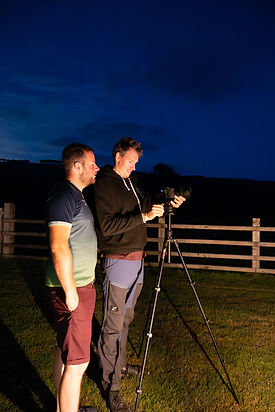
Stargazing Tips for Beginners
Allow 20–30 minutes for your eyes to adjust to the dark. Avoid white light — use red torches to preserve night vision
Use the star wheel and map to orient yourself
Keep your phone on night mode
Download a stargazing app if you're curious — or just lie back and watch the sky do its thing
Taking your stargazing to the next level
If you’re looking to elevate your stargazing adventures, Dafydd at Serydda is the one to guide you.


Get in Touch
Plan Your Retreat